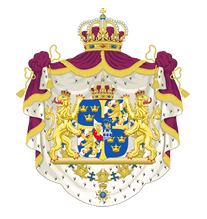

Sweden: Government
Principal Government Officials
Chief of State: King Carl XVI Gustaf
Head of Government: Prime Minister Fredrik Reinfeldt
Sweden's government is a limited constitutional monarchy with a parliamentary system. Popular government in Sweden rests upon ancient tradition. The Swedish Parliament (Riksdag) stems from tribal courts (Ting) and the election of kings during the Viking era. It became a permanent institution in the 15th century.
King Carl XVI Gustaf (Bernadotte) ascended to the throne on September 15, 1973. His authority is symbolic and representational. Executive authority is vested in the Cabinet, which consists of a prime minister and 22 ministers who run the governmental departments. The current "Alliance" government, led by Prime Minister Fredrik Reinfeldt, came to power in September 2006.
Sweden has three levels of government: national, regional, and local. In addition, there is a European level, which has acquired increasing importance following Sweden's entry into the EU and the EU’s adoption of the Lisbon Treaty. Parliamentary, municipal, and county council elections are held every 4 years. The 349-member unicameral Riksdag has legislative powers, and is in session generally from September through mid-June. Proposals for new laws are presented by the government, which also implements decisions made by the Riksdag. The government is assisted in its work by the Government Offices, comprising a number of ministries, and some 300 central government agencies and public administrations.
Sweden is divided into 21 counties (lan), 18 county councils (landsting), 290 municipalities (kommuner), and two semi-independent regions. Each county is headed by a governor, who is appointed by the central government. The counties coordinate administration with national political goals for the county. The county council (landsting) is a regional government that is popularly elected with particular responsibility for health and medical care. The municipalities are local governments that deal with issues such as education, public transportation and social welfare. Elected municipal councils are headed by executive committees roughly analogous to the boards of commissioners found in some U.S. cities.
Swedish law draws upon Germanic and Roman traditions. It is neither as codified as French law nor as dependent on judicial precedent as U.S. law. Legislative and judicial institutions include, in addition to the Riksdag, the Supreme Court, the Supreme Administrative Court, the Labor Court, the Law Council, District Courts and Courts of Appeal, and the Public Prosecutor's Office. The parliamentary ombudsmen and the Chancellor of Justice oversee the application of laws with particular attention to abuses of authority.
POLITICAL CONDITIONS
Ordinary general elections to the Swedish Parliament are held every fourth year on the third Sunday in September. County council and municipal council elections take place at the same time. A party must receive at least 4% of the votes in the entire country or 12% in a single electoral district to qualify for any seats in Parliament.
The most recent elections were held on September 19, 2010. The Alliance for Sweden (a coalition of four center-right parties--the Moderate Party, the Liberal Party, the Christian Democrats, and the Center Party) won 173 of the 349 seats, securing Moderate Fredrik Reinfeldt the position of Prime Minister. The 2010 election results for Sweden's major parties were as follows: the Social Democratic Party (30.66%; 112 seats), the Moderate Party (30.06%; 107 seats), the Green Party (7.34%; 25 seats), the Liberal Party (7.06%; 24 seats), the Center Party (6.56%; 23 seats), the Sweden Democrats (5.70%; 20 seats), the Left Party (5.60%; 19 seats), and the Christian Democrats (6.60%; 19 seats).
The Social Democratic Party (SDP) has a base of blue-collar workers and public sector employees. It derives much of its power from strong links with the National Swedish Confederation of Trade Unions (LO), which represents blue-collar workers. The party program combines a commitment to social welfare programs and government direction of the economy. The Social Democratic Party has led the government for 65 of the 78 years since 1932; the 2006 election ended its most recent term of 12 consecutive years in office.
The Moderate Party emphasizes personal freedom, free enterprise, and reduction of the public-sector growth rate, while still supporting most of the social benefits introduced since the 1930s. The party also supports a strong military and Sweden's membership in the EU. Its voter base is urban business people and professionals, but the party also attracts young voters, main-street shop owners, and, some blue-collar workers. Moderate Party Leader Reinfeldt has remodeled his party as "New Moderates," moving away from the party's right-wing, upper-class roots to appeal to a large middle ground of voters. In 2006, Reinfeldt was instrumental in uniting into one party, the Alliance, the previously separate four center-right parties.
The Green Party is a left-leaning, environmentalist party that attracts young people. The Greens strongly support greater public transportation and environmental taxation, and replacing nuclear energy in Sweden with alternative, environmentally friendly energy sources.
The Liberal Party's platform is "social responsibility without socialism," which includes a commitment to a free-market economy combined with comprehensive Swedish social welfare programs. Foreign aid, education, and women's equality also are popular issues. The Liberal Party base is mainly centered in educated, middle-class voters, and is pro-EU.
The Center Party maintains close ties to rural Sweden. The main priorities of the party include providing a sound economic climate for business and job creation, rural development, climate change and environmental concerns, and health and welfare issues.
The Sweden Democrats gained representation in Parliament for the first time in 2010. It is a nationalist, right-wing party. Its main priority is to protect Swedish culture and values, mostly by reducing immigration to Sweden. In the 2010 elections, the Sweden Democrats were particularly successful in getting votes from the unemployed, laborers, men, and those between 18 and 30 years old.
The Left Party, formerly the Communist Party, focuses on feminist issues, employment in the public sector, and the environment. It opposes privatization, cuts in public expenditure, Swedish participation in NATO activities, and EU membership. Its voter base consists mainly of young people, public sector employees, feminists, journalists, and former social democrats.
The Christian Democrat Party is conservative and “value-oriented”. Its voter base is primarily among members of conservative churches and rural populations. Christian Democrats seek government support for families and better ethical practices to improve care for the elderly.
FOREIGN RELATIONS
For much of the last 2 centuries, Swedish foreign policy had been based on the premise that national security was best served by staying out of military alliances in peacetime in order to remain neutral in the event of war. However, Sweden has been redefining this position in recent years. In its 2010 Foreign Policy Statement, the Swedish Government said that membership in the European Union means that Sweden is part of a political alliance and that Sweden accepts its share of responsibility for European security. This echoes a 2007 statement that Sweden would not remain passive if another EU or Nordic nation suffers a disaster or an attack and Sweden expects these countries to act the same way. Internationally, the Swedish Government gives special focus to disarmament, arms control, and nuclear nonproliferation. Sweden has greatly contributed to numerous international peacekeeping operations under UN, EU, and NATO auspices, including the NATO-led peacekeeping forces in the Balkans (KFOR). The country contributes to the International Security Assistance Force (ISAF) in Afghanistan, and in March 2006 assumed leadership of the Provincial Reconstruction Team in Mazar-e-Sharif. Sweden currently has about 500 troops deployed with ISAF. Sweden also has troops serving in Kosovo (KFOR) and in the EU anti-piracy mission ATLANTA off the coast of Somalia.
Sweden is an active and vocal participant in the United Nations, the World Bank, World Trade Organization (WTO), Food and Agriculture Organization (FAO), the International Labor Organization (ILO), International Atomic Energy Agency (IAEA), United Nations Educational, Scientific and Cultural Organization (UNESCO), World Health Organization (WHO), and other international institutions. In January 1995 Sweden became a full member of the European Union after a referendum was passed with a 52.3% majority. Sweden became a member partially because it was increasingly isolated outside the economic framework of the Maastricht Treaty. Sweden is a member of NATO's Partnership for Peace (PFP). Sweden also cooperates closely with its Nordic neighbors, formally in economic and social matters through the Nordic Council of Ministers and informally in political matters through direct consultation.
Government leaders focus political and financial attention on fostering democracy in developing countries, paying particular attention to key African nations. During the Cold War, Sweden was suspicious of the superpowers, which it saw as making decisions affecting small countries without always consulting those countries.
Sources:
CIA World Factbook (September 2009)
U.S. Dept. of State Country Background Notes (July 2011)